

Disaster Risk Reduction and Livelihoods - Livelihoods Centre


Agrégateur de contenus
According to the Hyogo Framework for Action, disasters affect over 200 million people annually, causing significant loss of lives, forced migration, and disruption of livelihoods and institutions. The trend over the past 15–20 years points to a greater frequency of environmental, climatic, political, and economic hazards and therefore a growing risk for vulnerable populations worldwide. Disaster Risk Reduction programs and policies offer the potential to reduce the effects of a disaster or shift the burden outside the affected community, yet there exist many gaps and unanswered questions. From 2010 to 2013, the Feinstein International Center, with support from the US Office of Foreign Disaster Assistance, conducted a three-country study of disaster risk reduction and livelihoods entitled “Disaster Risk Reduction and Livelihoods.” The report covers three case studies: Disaster Risk Reduction and Financial Strategies of the Poor: Demand for, Access to, and Impact of Cash in Haiti following the 2010 Earthquake; Living in the Margins: Coping with Flood Risks and Managing Livelihoods in Nepal’s Far-western Terai; and Conflict Management and Disaster Risk Reduction: A case study of Kenya.
The study identified three case studies to capture as much breadth and variety of disasters as possible, including geographical areas, affected livelihood assets, and population groups. The first category was the hazards that the case study would address. These include environmental and climatic hazards (all), tectonic hazards (Haiti), economic hazards (Haiti), and socio-political hazards (Nepal, Kenya). The second criterion is the type of livelihood assets addressed by programs, including physical (Nepal), natural (Nepal, Kenya), financial (Haiti, Nepal), human (Haiti, Kenya), and social/political (Nepal, Kenya, Haiti). The third was the population group (correlated with the livelihood group), and includes rural (Nepal, Kenya), urban (Haiti), and peri-urban (Haiti, Kenya). The last criterion was the geographic region, with one case each from the Latin America/Caribbean region (Haiti), one from Africa (Kenya), and one from Asia (Nepal).
Available in English.
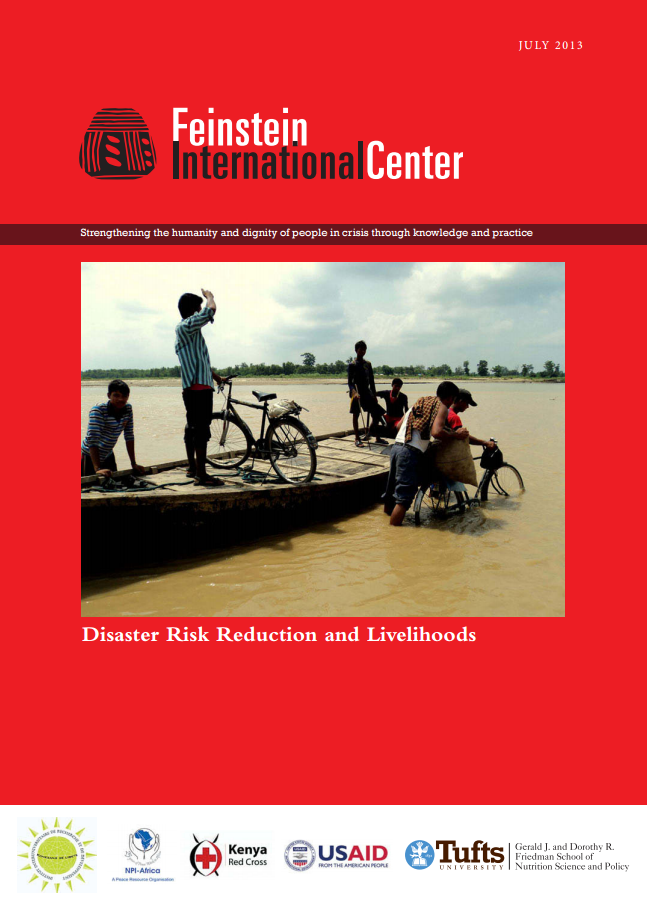
- Organisation: Feinstein International Center. Tufts University
- Pages: 178
- Année de publication: 2013
- Droit d'auteur: ©2013 Feinstein International Center
- Url: http://fic.tufts.edu/publication-item/disaster-risk-reduction-and-livelihoods/